Boilerplate, brand files, and a direct line for interview and comment requests on artificial superintelligence risk.
For deadline press, put Press and your outlet in the subject line. We aim to reply within one business day; same-day when we can. We do not accept money from AI laboratories or their investors, and we will say so on the record.
Use the form at the bottom of this page, or write through Contact. LinkedIn: Nakada Foundation.
Use these as-is in articles, show notes, and chyrons. Prefer the short form when space is tight.
The Nakada Foundation to Save Humanity is an independent public-education campaign working to prevent the creation of artificial superintelligence. It takes no money from AI laboratories or their investors.
The Nakada Foundation to Save Humanity is a philanthropic public-education campaign focused on one goal: making sure artificial superintelligence is never built. The Foundation works through culture, media, convening, and coalition so that a binding international treaty prohibiting ASI becomes politically possible. It does not train models, sell AI products, or take funding from AI laboratories or their investors. Learn more at nakadafoundation.org.
The Nakada Foundation to Save Humanity is an independent philanthropic campaign working to prevent the creation of artificial superintelligence. The Foundation is not a lab and not an ethics board for chatbots. Its brief is systems that would exceed human intelligence across domains and cannot be reliably corrected or shut down.
The end state the Foundation wants is binding international law. It does not draft treaty text itself. It does the cultural and soft-power work that shapes elite and public understanding: narrative, media, convening, and relationships that raise the political cost of racing ahead. It models its approach on campaigns that moved when the science was clear and the politics were not, from nuclear non-proliferation to the ozone layer.
The Foundation is an unincorporated philanthropic association in the United States, seeking fiscal sponsorship under a 501(c)(3). It is nonpartisan, accepts no money from AI laboratories or their investors, and publishes its materials at nakadafoundation.org.
Download files for print and digital. Keep clear space around the wordmark. Do not recolor, stretch, or place the cream logo on a light field.

Primary logo for dark slides, video lower-thirds, and dark web placements. PNG, 684×192.
Download PNG

Dark gray wordmark for light slides, print, and light web placements. PNG, 684×192.
Download PNGCompact mark for avatars and small UI. SVG preferred; PNG and Apple touch icon also available.
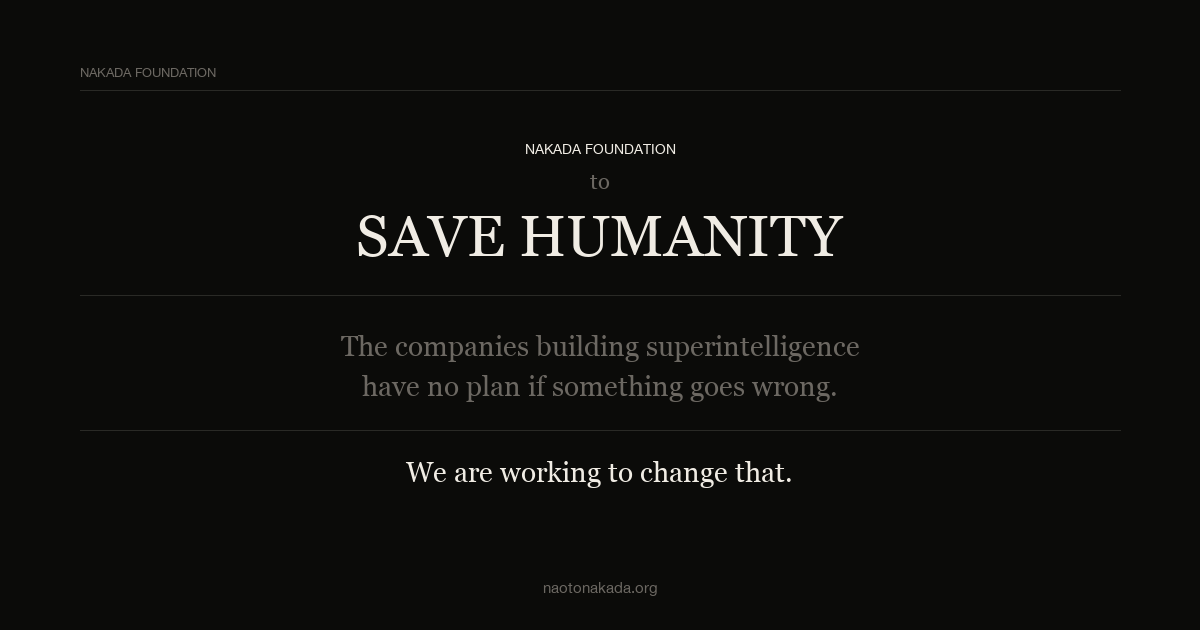
Download SVGAlso available: Apple touch icon (180×180), favicon 96×96, default Open Graph image (1200×630). Name in first reference: Nakada Foundation to Save Humanity. Later references may use Nakada Foundation.

We stay on superintelligence and the politics of preventing it. We will decline freestanding stories on chatbot bias, deepfakes, or lab product launches when they are not tied to ASI.
Why the Foundation’s ask is to stop ASI permanently. Superintelligence cannot be controlled by humans. That is not a temporary slowdown of the race.
How “we have to beat China” framing locks in mutual risk, and what historical arms-control cases suggest about getting out of it.
Why public narrative, film, prestige, and elite attention are treated as the underfunded path to a treaty, not a side project.
Structural conflict when safety work is funded by, or staffed for career paths inside, the companies racing the frontier.
Start here before a call. These pages are written to be cited.
Mission, scope, organizational status, and what the Foundation deliberately does not do.
How cultural pressure is meant to make a binding ASI prohibition politically possible.
Why artificial superintelligence is treated as a civilizational risk, in plain language.
One-pagers, PDFs, and visuals suitable for background packs.
Directory of independent organizations working on related problems.
Essays and explainers already published under Foundation bylines.
Tell us your outlet, deadline, and the angle. For on-camera or podcast bookings, include format, length, and time zone.
Subject tip: start with “Press:” plus your outlet name.