AI Safety Treaty & Governance Policy Plan, Change comes from law,
not from laboratories.

The technical community has spent a decade warning. The warnings did not slow the labs. What is missing now is political will, legal frameworks, and a coalition strong enough to halt the race to systems nobody can control.

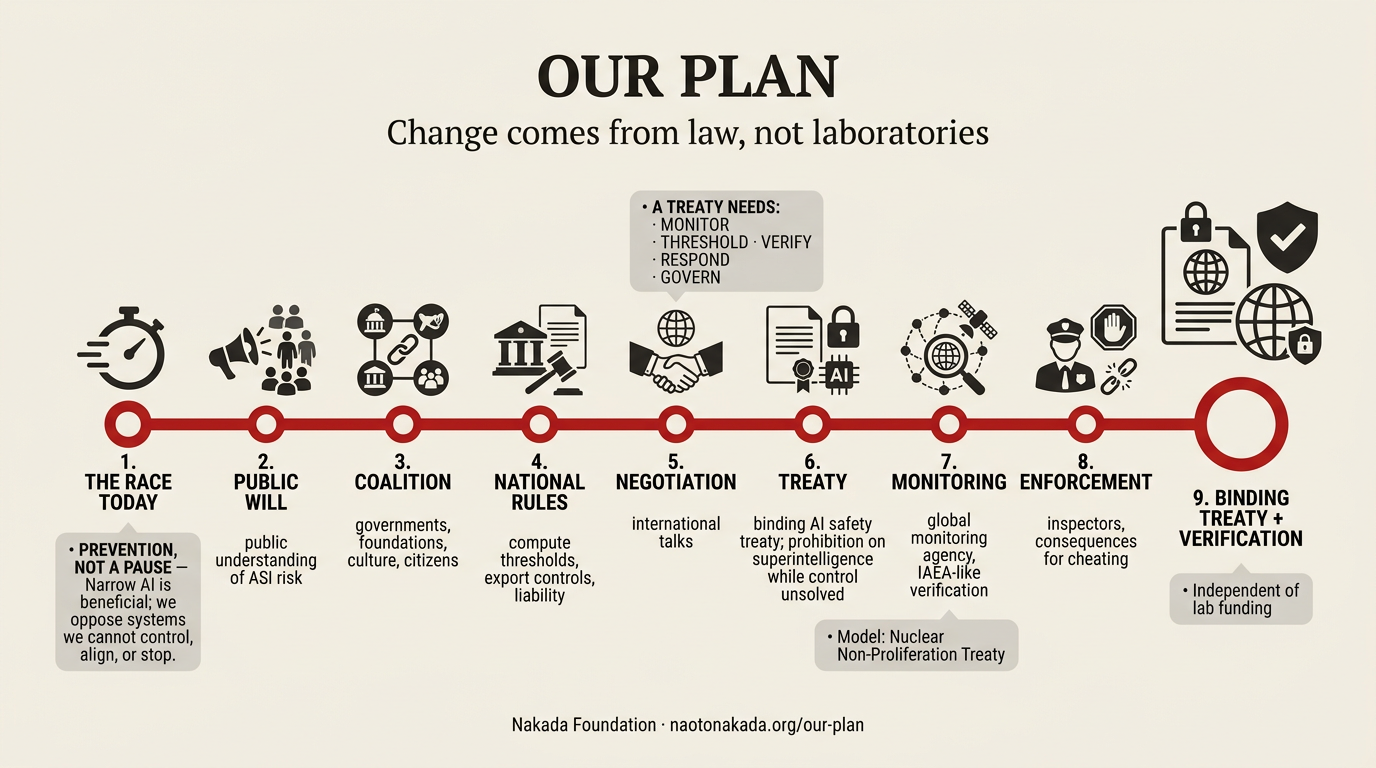
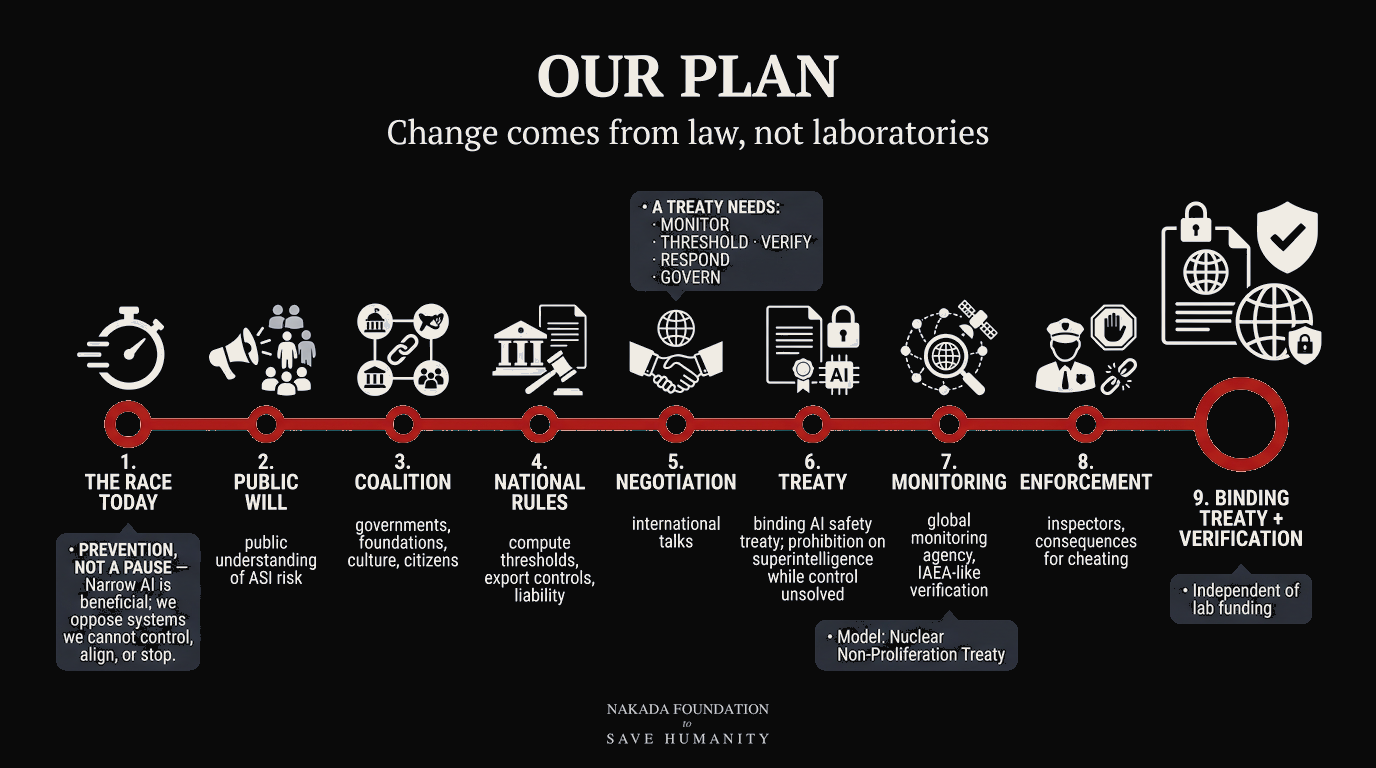
Infographic: Our Plan subway map from the race today to a binding treaty and verification
From the race to a binding treaty. All visual infographics →

Why we exist.

The Nakada Foundation to Save Humanity was established on a single premise: that the most consequential decisions in human history, decisions that will determine whether our species survives, should not be made by a handful of engineers at five corporations in one country.

We are not aligned with the AI safety research establishment, which is largely funded by the same laboratories that are racing to build the systems it studies. We believe the incentive structure of the AI safety field is fundamentally compromised, and that the solution will not come from within the industry.

Narrow AI is transformative and beneficial. It can cure diseases, accelerate discovery, and expand human potential. We are not against AI. We are against building a form of intelligence that we cannot control, cannot align, and cannot stop.

Change requires external pressure: from governments, from law, from culture, and from people who understand that what is at stake is not a market outcome but the survival of the human species. We have a model for this. It is called the Nuclear Non-Proliferation Treaty.

Not a research lab

Unlike AI safety research organizations, we do not build, train, or experiment on AI systems. We do not accept funding that would create a conflict between our mission and our message.

Not an ethics body

Unlike AI ethics organizations, we focus exclusively on existential risk: not bias, fairness, or misuse of existing AI. These are important issues. They are not the same issue as extinction.

A campaign

We operate like a political movement, not an academic institute. We seek to shift public opinion, build coalitions, and change law, the way every successful social movement in history has operated.

Prevention, not a temporary pause.

People often file us under "pause": a few years of breathing room so the labs can make superintelligence safe and then resume. That is not the ask. We want governments to prevent artificial superintelligence, and to keep preventing it until the science of controlling a mind smarter than ours actually exists. Today that science does not.

The difference is load-bearing. A pause assumes a schedule problem: slow down, let safety catch up, hit go. Nobody has a validated way to control a system more capable than its makers. Not at small scale. Not at large. Not one proven method. The people racing to build it say so in public.

If that remains true, then building superintelligence under anything like today's methods does not produce a risky technology to be managed carefully. It produces an outcome from which there is no recovery. This is the argument made most bluntly in the 2025 book If Anyone Builds It, Everyone Dies, by Eliezer Yudkowsky and Nate Soares. You need not accept every claim in it to see the asymmetry: we would get exactly one attempt, and no one can tell you how to get it right.

So the treaty we advocate is not a way to make the development of superintelligence safe. There is no known way to do that. The treaty is the off-ramp from the race, a decision not to take the gamble at all, for as long as the gamble cannot be made survivable.

This is why we part ways with much of the AI safety field. A great deal of "safety" work quietly assumes the systems will be built and tries only to lower the odds they kill us. We think that inverts the problem. When you cannot control the downside, and the downside is everyone, the responsible move is to stop building the dangerous thing until the control problem is genuinely solved, not to build more carefully. Narrow AI (the kind that cures diseases and accelerates discovery) continues. It is the narrow class of systems that would exceed human intelligence across every domain that must not be built yet.

How we operate.

01

Policy & Lobbying

Direct advocacy in Washington D.C., Brussels, London, and with United Nations bodies. We are focused on binding frameworks, not voluntary guidelines, that prohibit the development of superintelligent AI systems.

Our policy work targets three chokepoints: compute infrastructure, where a small number of chip manufacturers control the hardware needed to train frontier models; frontier AI labs, where commercial incentives override safety commitments; and international bodies, where treaty frameworks must be built before capability races become irreversible.

02

Coalition Building

Engaging the world's largest philanthropic foundations, heads of government, Nobel laureates, celebrities, and cultural figures to amplify the message, fund the cause, and shift the Overton window.

The history of effective advocacy is the history of unlikely coalitions. The civil rights movement united clergy, labor unions, and lawyers. The nuclear disarmament movement brought together physicists and poets. We are building the coalition that will make AI safety the defining political issue of this decade.

03

Culture & Awareness

Commissioning art, film, journalism, and media that makes the danger visceral and undeniable. The climate movement failed for decades in part because the threat was abstract and distant. AI risk is neither, but it must be made to feel immediate.

Safety must be made prestigious, urgent, and impossible to ignore. We are working with filmmakers, novelists, game designers, and journalists to build the cultural infrastructure for a movement that will last.

Three specific demands.

These are concrete moves governments can make with tools that already exist. Each one has a precedent with a name and a year.
01

Compute Governance

Require government licenses for training runs exceeding a defined compute threshold (currently proposed at 1026 floating-point operations). Mandate independent safety audits before deployment. Create a verified, international registry of all frontier model training runs. Compute is the chokepoint: a small number of manufacturers, principally TSMC, NVIDIA, and ASML, control the hardware required to build frontier AI systems, which makes licensing at the compute layer technically straightforward and verifiable.

A ceiling only holds if the hardware itself is tracked. The advanced GPUs these training runs depend on can be registered and, increasingly, built to verify on-chip where they are and what they are doing, tamper-evident location attestation and usage limits set in the silicon, so a legal cap becomes a physical one. This is also the answer to offshoring: without hardware-level tracking, a lab that hits the ceiling at home simply moves its training run to a permissive jurisdiction. Extending export controls and chip-level verification across the whole supply chain is what keeps compute from quietly draining to wherever the rules are weakest. How hardware-enabled verification works → · Compute governance explained →

02

International AI Safety Treaty

A binding multilateral agreement to prohibit the development of AI systems exceeding a defined general capability threshold, modeled on the Nuclear Non-Proliferation Treaty. No nation should be exempt. This is not a moratorium to be lifted on a schedule; it is a prohibition that holds until the alignment problem is genuinely solved, if it ever is. The NPT is imperfect, but it has prevented nuclear weapons use for eighty years. The standard objection ("other countries will defect") is precisely the argument made against nuclear non-proliferation. The answer is not to race. The answer is a treaty with verification mechanisms. Why the current AI treaty is not enough →

03

Global AI Monitoring Agency

An intergovernmental body with inspection rights, analogous to the International Atomic Energy Agency, empowered to verify compliance with compute limits and mandate safe development practices at frontier AI laboratories. The IAEA was created within three years of the Nuclear Non-Proliferation Treaty. A Global AI Monitoring Agency is achievable on the same timeline if the political will exists. Its mandate would include mandatory reporting of training runs, on-site inspections of major AI laboratories, and the authority to issue binding recommendations to member states. What it would take to build one →

What enforcement costs,
and why it is worth paying.

A treaty is only as real as its enforcement. Campaigning for one without naming the bill would be a con. The costs are real. Measured against what they buy, they are still small.

Intrusive verification

Meaningful enforcement means on-site inspection of data centers, mandatory declaration of large training runs, and hardware that reports its own location and use. That is an intrusion on commercial secrecy and, handled carelessly, on privacy. The nuclear inspection regime accepts the same intrusion because the alternative is worse. The safeguard is that the monitoring is international and transparent, not owned by any single state or company.

Forgone upside

Holding superintelligence back means deferring whatever benefits a controllable version might one day deliver, and asking companies and countries to leave extraordinary short-term profit on the table. This is a genuine cost. But an uncontrollable superintelligence delivers those benefits to no one, a system you cannot align is not an asset you get to keep. Deferring a prize no one can safely claim is not much of a sacrifice.

A hard edge

Rules without consequences are suggestions. Enforcement only works when violations carry weight: export denial, financial sanctions, exclusion from the compute supply chain, and (as with fissile material) a shared understanding that a rogue project to build superintelligence is everyone's emergency, not a private one. Building that edge is hard and politically expensive. Every serious arms-control regime has required it anyway.

The costs of enforcement are bounded. The cost of no enforcement is not.

Every objection to enforcement (that it is intrusive, expensive, and constrains industry) is true and survivable. The one outcome that is not survivable is the one enforcement exists to prevent. We pay bounded, known costs to rule out an unbounded, irreversible one. It is the same trade civilization already made for nuclear, chemical, and biological weapons. On deterrence and enforcement between states →

Can a treaty really be verified? →